Release v1.2 Hundreds of thousands of variables → The planning workbench for operations
Supply chain optimization. Without the OR team.
Staffing, replenishment, placement, markdown timing: the decisions you re-make every week. Describe one in plain English. LogiModel optimizes it on your live data and explains the answer in dollars. You make the call. The solver does the math.
Orders delivered 13
On-time 100.0%
Solve status OPTIMAL · $3,420
What changes
Four numbers the solver moves.
The ranges to expect when weekly planning comes off the spreadsheet.
Modeled ranges: your own baseline-vs-optimized comparison is the real number.
What the agents run for you
Eight decisions, one workbench.
Each is a real solver problem: capacity caps, SLAs, dollars at stake. Modeling one used to take an OR team. Now agents run all eight, every week.
01
Driver staffing
How many drivers tonight to hit the promise?
02
Workforce shift planning
What FT/PT mix covers tomorrow's peaks?
03
Fulfillment placement
Which nodes serve which zones, at what promise?
04
Carrier & zone allocation
Which carrier on each lane, under capacity caps?
05
SKU replenishment
When, and how much, to reorder?
06
Channel spend
Where does the next marketing dollar go?
07
Markdown timing
When to discount aging inventory, and how deep?
08
Peak demand & expansion
How much capacity for peak, and when to open the next zone?
Your decision isn't here? Tell us about it. Most of these started as one planner's problem.
Baseline vs optimized
Your network, before and after the solver.
Your live baseline against the solver's plan, in the metrics you already report. Toggle to see what the optimization gives back.
Same data, same constraints, a solver-backed plan. (Figures modeled.)
How it works
How a sentence becomes a plan.
No new hires, no new ERP. A planning layer above the stack you already run.
01 · Capture
Describe the decision. The agent builds the model.
Say what you're staffing, replenishing, or allocating, in plain English. The agent turns it into a solver-ready optimization model.
ERP
WMS
Sheets
LogiModel
Plan
Twin
02 · Solve
The right solver, picked and run for you.
The agent picks the right solver and runs the optimization end-to-end, even for the SKU × node × week problems that take minutes.
Plan vs actual vs twin
Plan Actual Twin
M T W T F
03 · Decide
Ask what-if the way you'd ask an analyst.
Ask what a planner would ask: what if carrier A drops 10% capacity, or the Shanghai lane slips five days? The agent answers in plain language and re-solves under your overrides. Save the scenario, rerun it next week.
You
What if lead time on the Shanghai lane increases by 20%?
Twin
Coverage at ATL-3 drops below 5 days for 12 SKUs by Thu. Reroute through Long Beach + lift safety stock on top movers. Service holds, freight up 4.2%.
Generate plots Compare baseline Commit
Ask the twin…
The benchmark
The math checks out: 90.1% on NLP4LP, state of the art.
NLP4LP is the field's standard test: 332 optimization problems, scored on getting the right answer. Anvil, our deterministic compiler, beats the leading LLM-driven system, OptiMUS, while running on a free, open-source solver.
Read the benchmark → LogiModel AI
90.1%
OptiMUS · o1
80.6%
OptiMUS · GPT-4o
NLP4LP accuracy · 332 problems · higher is better 73.7%
Inside the workbench
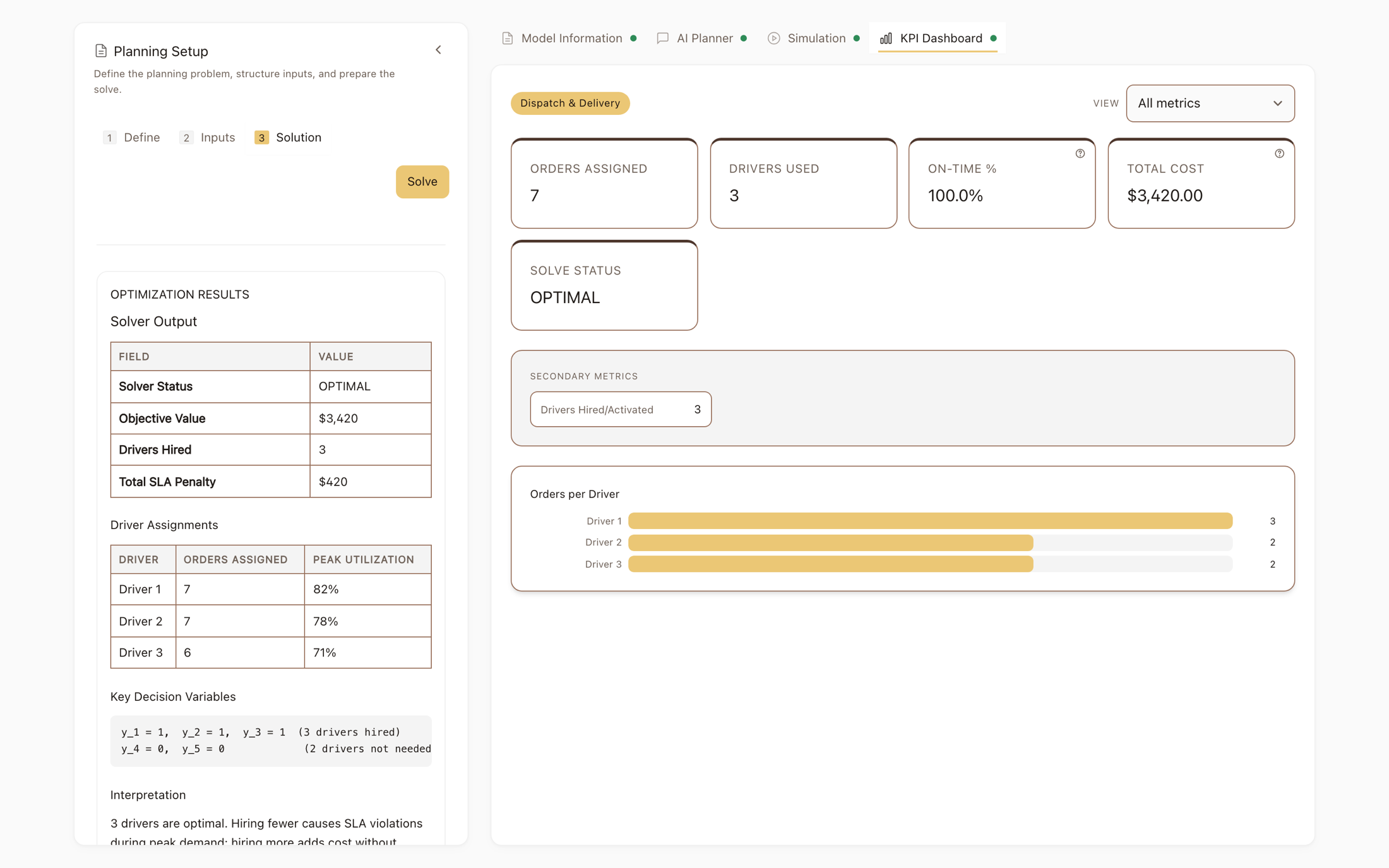
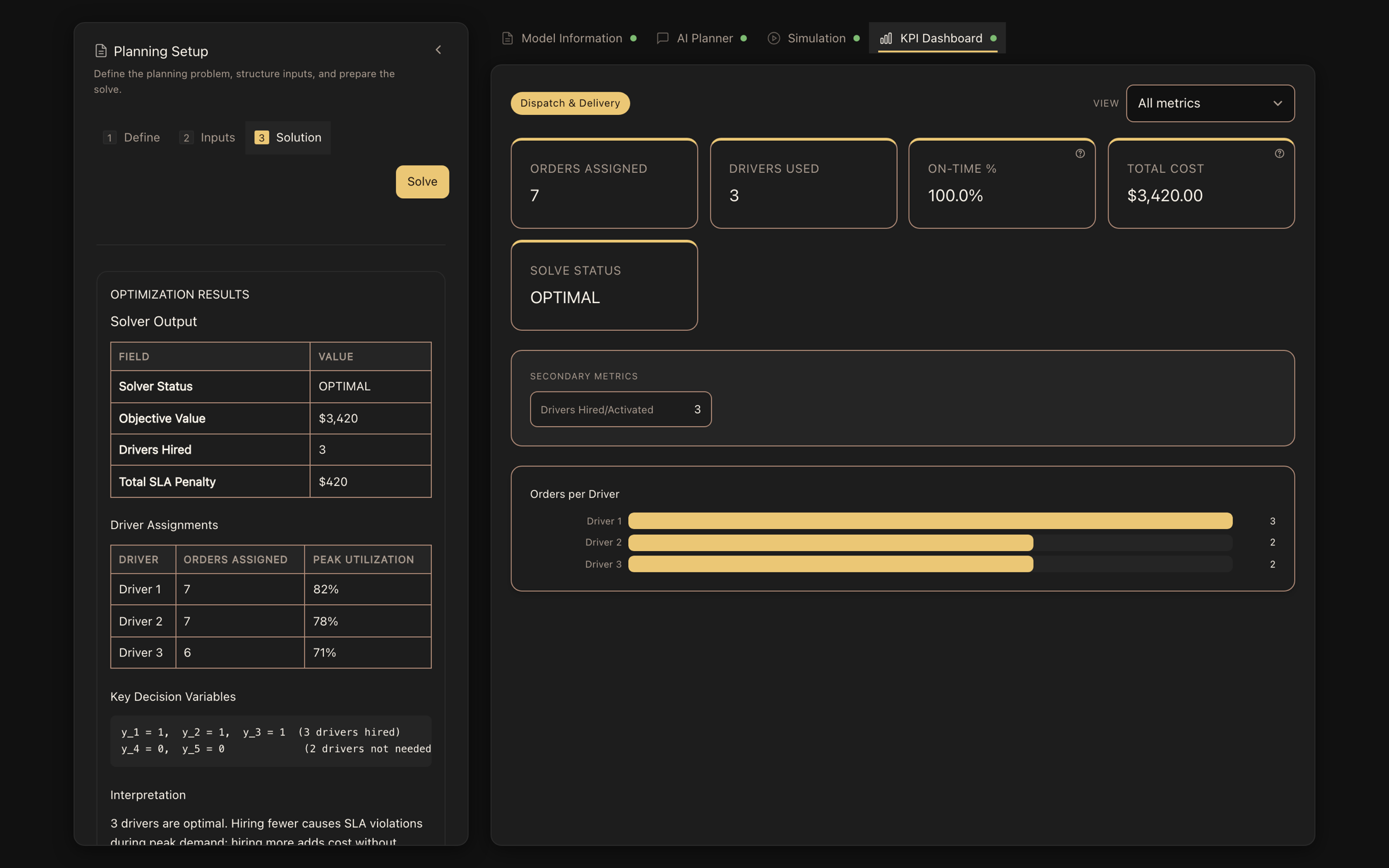
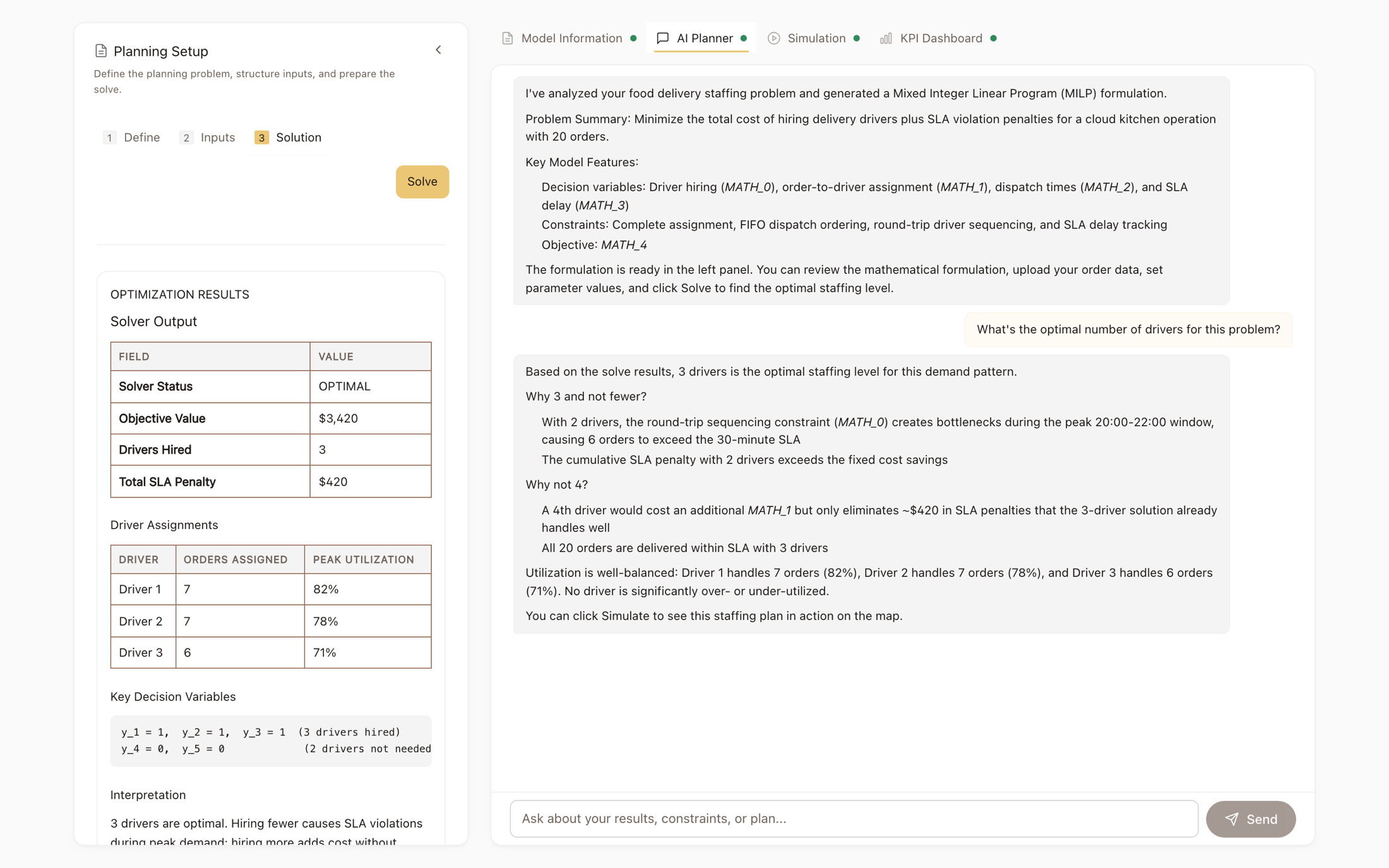
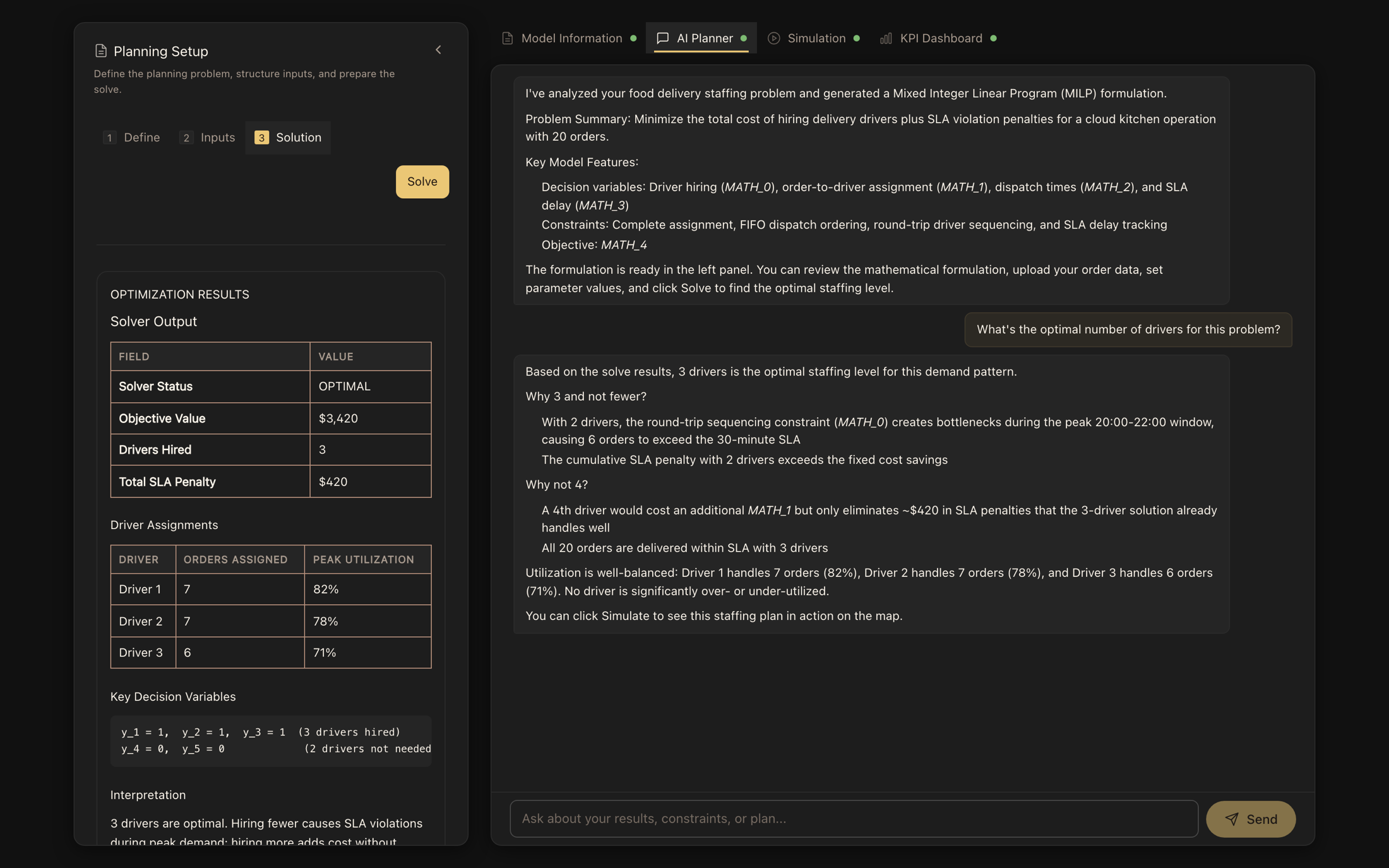
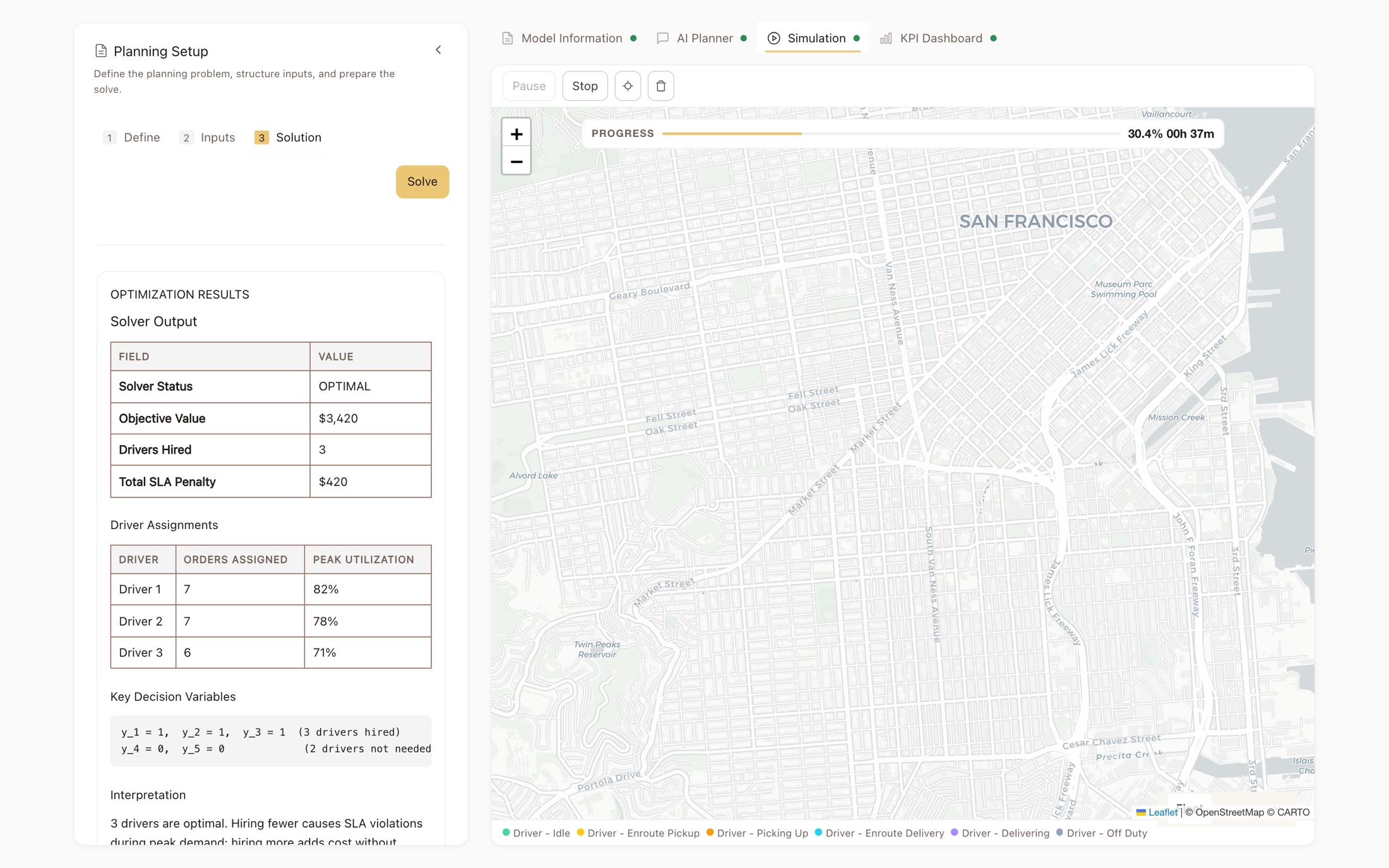
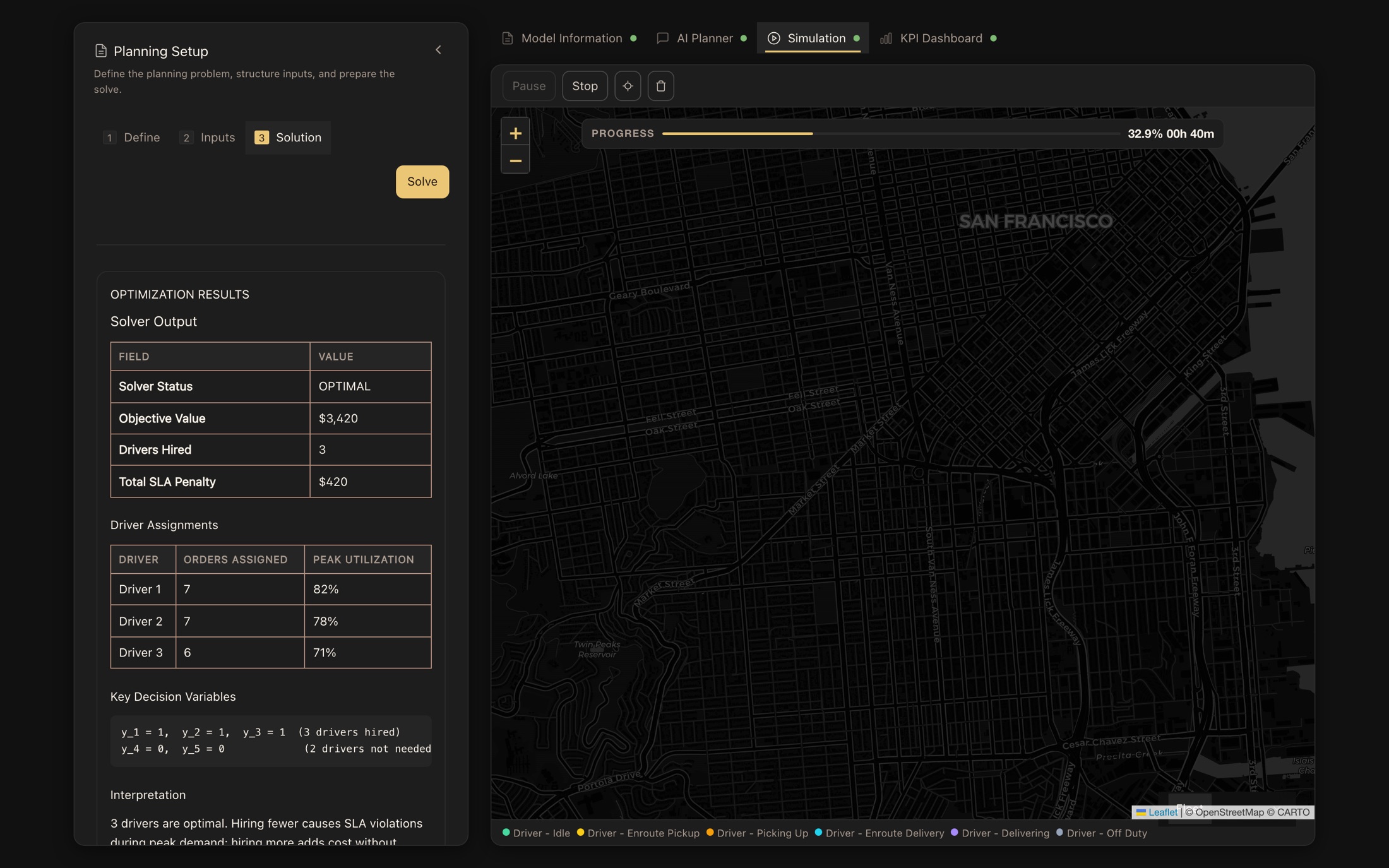
This is the screen Monday's plan runs on.
One workspace: the agent explains the model, the solver returns the numbers, and a live twin plays the plan back on your network.
Working sessions
Your first optimized plan is 30 minutes away.
Bring one decision to a 30-minute working session. Watch the agent capture it and the solver run it. Leave with a baseline-vs-optimized comparison you can ship Monday.